KB Research Presented at SBM
Klein Buendel researchers, Dr. Kayla Nuss and Ms. Julia Berteletti, and their collaborators presented two novel posters at the 47th Annual Meeting and Scientific Sessions of the Society of Behavioral Medicine (SBM) in Chicago, IL on April 22-25, 2026.
*Klein Buendel authors are bolded.
POSTER 1
Title: Applying Body Neutrality Principles to Physical Activity Promotion: A Pilot Test of the Body Neutrality Playbook
Presenter: Dr. Kayla Nuss
Collaborators: Anne Poirier, Amanda Brice, Sierra Held, Taylor Sullivan, Noah Chirico
This pilot study examined preliminary effects of the Body Neutrality Playbook on physical activity behavior, Self-determination Theory (SDT) motivation, and body image–related constructs in women insufficiently active at baseline.
Body image concerns and weight stigma can undermine motivation for physical activity, particularly among women not meeting public health recommendations. The Body Neutrality Playbook is a six-week, self-guided workbook grounded in body neutrality principles, designed to promote sustainable physical activity by fostering autonomous motivation, self-compassion, and body appreciation while reducing harmful appearance-based cognitions.
Twenty adult women completed the Body Neutrality Playbook over six weeks. Measures were collected at baseline and post-intervention, including self-reported weekly minutes of moderate-to-vigorous physical activity (MVPA), physical activity intention, physical activity planning, SDT-based motivation (intrinsic, integrated, identified, introjected, external), basic psychological needs satisfaction (competence, autonomy, relatedness), body functionality appreciation, body compassion (body kindness, motivated action, common humanity), internalized weight bias, and physical appearance comparison. Analyses examined mean change scores and Cohen’s d effect sizes to assess preliminary intervention impact.
Post-intervention, participants demonstrated meaningful increases in MVPA minutes per week, physical activity intention, and physical activity planning. SDT outcomes showed increased competence and autonomy, decreased introjected regulation, and increased integrated regulation and intrinsic motivation. Body image–related outcomes indicated increases in body appreciation, decreases in physical appearance comparison, and improvements in two of three body compassion subscales (body kindness and motivated action). Effect sizes for these changes were in the small-to-large range, suggesting practical significance despite the small sample.
Preliminary findings suggest the Body Neutrality Playbook may promote both autonomous physical activity motivation and positive body image while reducing appearance-based self-comparisons among women who are insufficiently active. The combination of body neutrality principles and SDT-informed behavior change strategies may address both psychological and behavioral barriers to physical activity. Future research with larger, more diverse samples and a controlled design is warranted to evaluate efficacy and mechanisms of change.
This research was sponsored by Klein Buendel and led by Dr. Kayla Nuss. Anne Poirier is from Shaping Perspectives.
POSTER 2
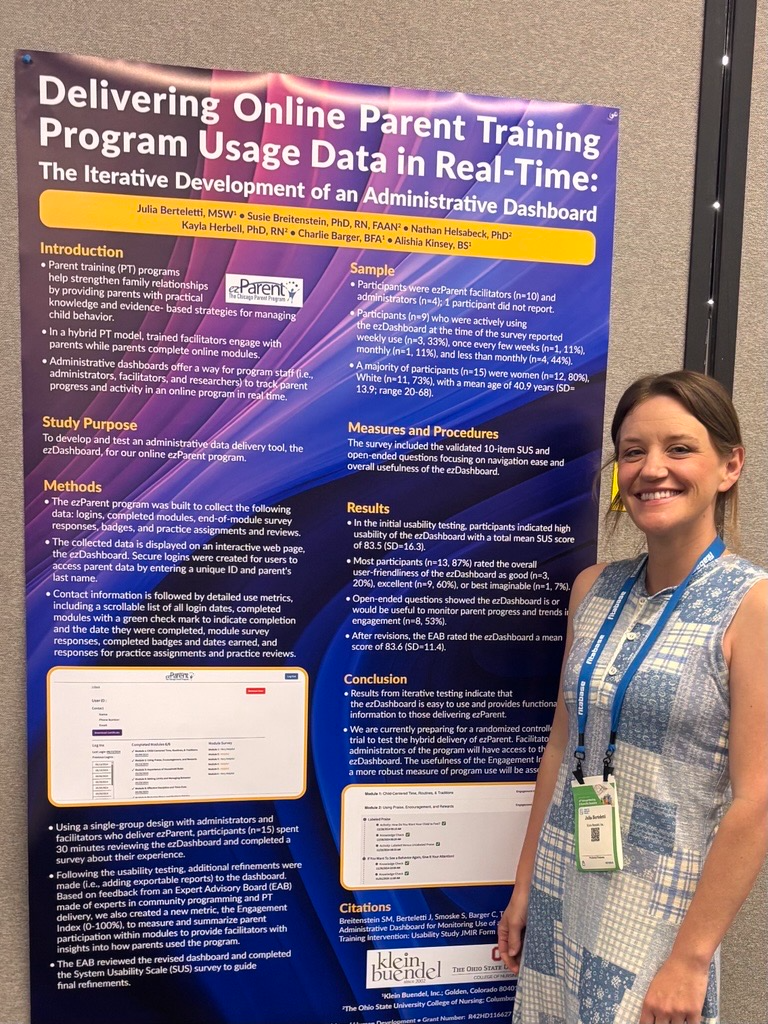
Title: Delivering online parent training program usage data in real-time: the iterative development of an administrative dashboard
Presenter: Julia Berteletti
Collaborators: Dr. Susie Breitenstein, Dr. Nathan Helsabeck, Dr. Kayla Herbell, Charlie Barger, Alishia Kinsey

Online parent training programs help strengthen parent-child relationships by providing parents with practical knowledge and evidence-based strategies for managing child behavior. In a hybrid parent training model, facilitators engage with parents while parents complete online modules. Administrative dashboards offer an integrated platform for program staff (administrators, facilitators, researchers) to track parent progress and activity in online parent training modules in real time.
The research team iteratively developed and tested an administrative data delivery dashboard of the online ezParent Parent Training program. Using a single-group design with administrators and facilitators who deliver ezParent, 15 participants spent 30 minutes reviewing the ezDashboard and completed a survey about their experience. The survey included the validated 10-item System Usability Scale (SUS) and open-ended questions focusing on navigation ease and overall usefulness of the ezDashboard. Following the usability testing, we made additional refinements (adding exportable reports) to the dashboard. Based on feedback from an Expert Advisory Board (EAB) made of experts in community programming and parent training delivery, we also created a new metric, the Engagement Index, to measure and summarize parent participation within modules to provide facilitators with insights into how parents used the program. The EAB reviewed the revised dashboard and completed the SUS survey. Final refinements have been completed.
In the initial usability testing, participants indicated high usability of the ezDashboard with a total mean SUS score of 83.5. Most participants (n=13, 87%) rated the overall user-friendliness of the ezDashboard as good (n=3, 20%), excellent (n=9, 60%), or best imaginable (n=1, 7%). Open-ended questions showed the ezDashboard is or would be useful to monitor parent progress and trends in engagement (n=8, 53%). To facilitate that, we created the Engagement Index (0-100% per module) to assist facilitators’ understanding of how parents interact with ezParent. After revisions, the EAB rated the ezDashboard as 83.6.
Results from iterative testing indicate that the ezDashboard is easy to use and provides functional information to those delivering ezParent. Next, the ezDashboard will be used in a randomized controlled trial testing hybrid delivery of ezParent. The usefulness of the Engagement Index as a more robust measure of program use will be assessed.
This STTR grant was awarded to Klein Buendel by the Eunice Kennedy Shriver National Institute of Child Health and Human Development (HD116627; Dr. Susan Breitenstein, Principal Investigator from Ohio State University). Research collaborators include Julia Berteletti from Klein Buendel, and Dr. Amie Bettencourt and Dr. Deborah Gross from Johns Hopkins University.
The ezParent technology was designed and programmed by the Creative Team at Klein Buendel.